
Collaboration works. During my past ten years at the Institute for Conservation Leadership, I have fortunately seen many successes. One of my favorite examples is in Carbon County, Pennsylvania, where a $10 million bond referendum for land conservation passed in November 2022 with the highest level of support of any such measure in the country that year (83%). Leading up to that, with Delaware River Watershed Initiative funding, Audubon Mid-Atlantic, Natural Lands, and Wildlands Conservancy built relationships with the county’s Planning and Development Office and the Carbon Chamber & Economic Development Corporation. With local leaders, the groups launched a Carbon County Return on Environment study that paved the way for the referendum. The partners’ efforts resulted in success none could have achieved alone.
Collaboration takes time and resources. When leaders consider opportunities to work with others, the first two things I often hear are “Will it be worth it?” and “We don’t want to collaborate for collaboration’s sake.”
New evidence from the National Fish and Wildlife Foundation (NFWF) shows that collaboration is worth it. A recent NFWF evaluation investigated whether a shift to supporting collaborative models in their Chesapeake Bay Program’s Innovative Nutrient and Sediment Reduction (INSR) grant program accelerated the implementation of best management practices (BMPs) at landscape scales. The evaluators found both qualitative outcomes and quantitative accomplishments resulting from NFWF’s investments.
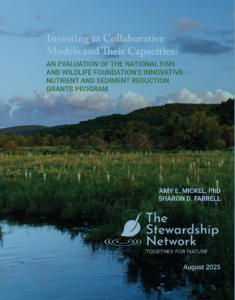
Amy E. Mickel, PHD and Sharon D. Farrell of The Stewardship Network
Investing in Collaborative Models and Their Capacities: An Evaluation of the National Fish and Wildlife Foundation’s Innovative Nutrient and Sediment Reduction Program.
The evaluation was a collaboration among the Stewardship Network, University of Virginia’s Institute for Engagement and Negotiation, NFWF and others.
Read the Executive Summary
Read the Full Report
- Landscape-scale restoration requires collaboration. The complexity of both the challenges and what is needed to address them requires the differing resources, expertise, and capacities of multiple entities working together.
- With INSR funding, grantees were able to invest in a wide range of collaborative support, including dedicated staff, development of systems and plans, and capacity to support learning, coordination, and technical assistance. This increased capacity “enabled grantees to generate 15 distinct types of interconnected impacts”, which you can see grouped into four classifications based on the Collaborative Capacity Impact Model ™.
- Collaborative processes led to quantitative accomplishments related to Best Management Practices (BMP) implementation, estimated reductions in nitrogen, phosphorus and sediment, and a 155% return on NFWF’s investment.
- The evaluation “provides robust evidence that collaborative models – properly resourced – accelerate positive impacts and build durable solutions to complex environmental challenges.”
- “Measure what matters. Expanded performance metrics, including social and organizational impacts, can more accurately capture collaborative effectiveness and outcomes.” Practitioners and funders alike will find helpful examples in the report.
- The INSR program’s “strategic pivot to support collaboratives…provides a replicable framework that could be applied nationwide for the ways collaborative models – when adequately resourced – can drive systemic, scalable, and sustained environmental change.”
Using the Evaluation to Inform Your Collaborative Work
“Collaborative models” encompasses a range of structures and approaches groups use to work together – think networks, coalitions, and partnerships. Whether you are already partnering with others or contemplating it, this report provides information, examples, and tools that can support your work.
- The evaluation is full of spotlights, quotes, and examples from a wide variety of collaborations. Because there is no uniform way to establish or structure a collaborative, identify options and ideas that may work for or inspire your group.
- “Measure what matters.” As you look for ways to articulate the impacts of your collaboration, you can use the list of 15 impacts found in the evaluation to reflect on the results of your existing partnership work and to plan for future collaborations. For example, ask: Which of these impacts are we seeing now? Which additional impacts do we want to plan and strive for? Which impacts do we want to design for?
- Use the Collaborative Capacity Impact Model as a resource with your planning group or steering committee. It is short, has great visuals and you can use it to read and reflect upon as a group.
- Funders can use the evaluation to inform ways your investments can support grantees and your organization to accelerate and measure their impact. The INSR program’s “strategic pivot to support collaboratives…provides a replicable framework that could be applied nationwide for the ways collaborative models – when adequately resourced – can drive systemic, scalable, and sustained environmental change.”
How ICL Can Support You to Strengthen Your Collaborative Capacity
The INSR evaluation confirms a premise of the Institute for Conservation Leadership’s work – higher functioning groups get more work done on the ground.
Well-facilitated meetings are a key vehicle for contributing to the 15 different types of impacts outlined in the evaluation and the Collaborative Capacity Impact Model. For example, knowing how to engage and connect meeting participants can enhance connectivity, trust, and resource sharing.
Build your essential collaboration skills by joining one of our upcoming leadership development programs.
- There are still a few spaces in February’s Facilitating Engaging Meetings training.
- Join Energize Your Partnerships and Networks (3 sessions in March/April) to develop skills and practical tools for engaging groups towards more effective collaboration.