
The Platte River and Its Ecosystem
Imagine a river that once was described as a mile wide and an inch deep. Historically, that was the braided river system named the Platte River, flowing through what is now Nebraska.
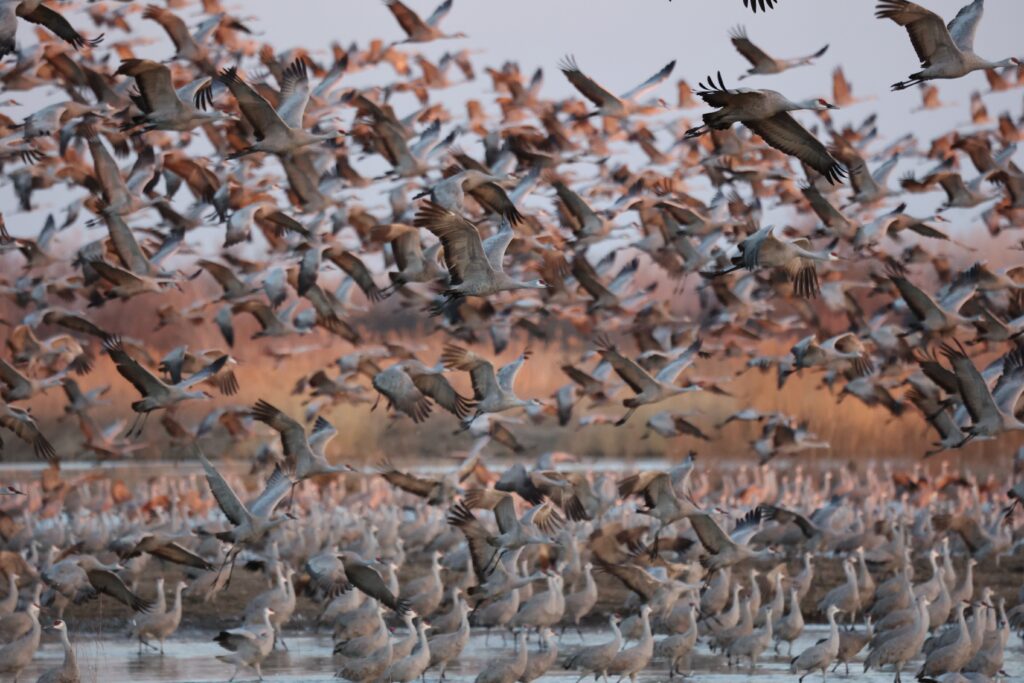
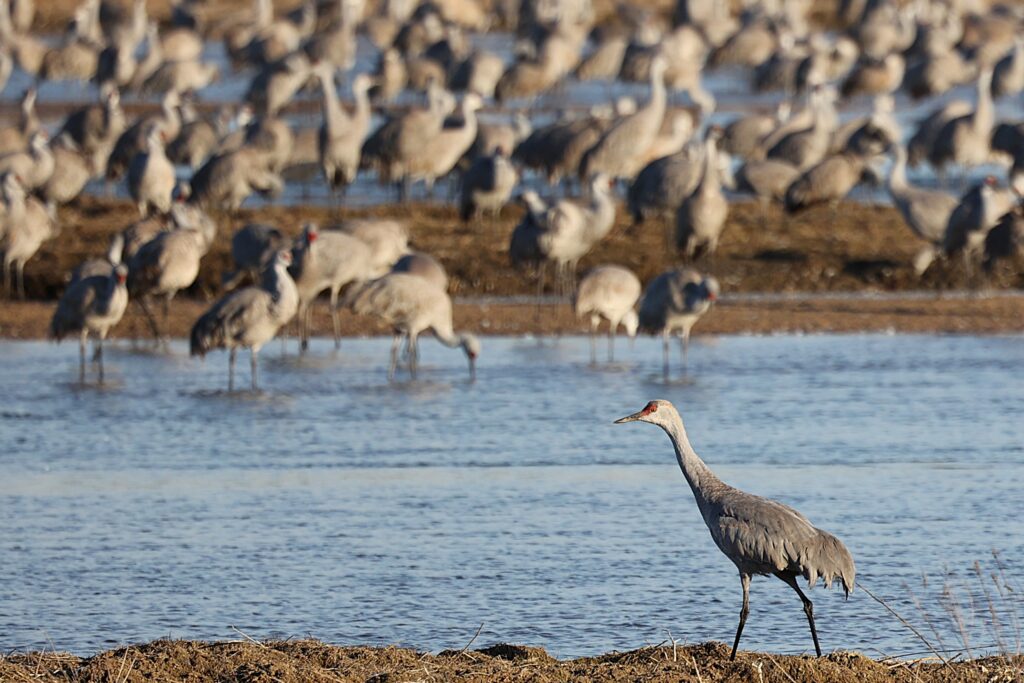
Now imagine roughly 1.2 million cranes converging on the Central Platte River Valley every spring for a four-to-six-week period for the last thousand years. At night, they roost in the wide river channel. At daybreak, they leave the river to forage for food all day, and at sunset, they return to the river to remain safe from predators.
The last 150 years of settlement of Wyoming, Colorado, and Nebraska have altered and threatened these images and realities. The Platte River ecosystem has been significantly altered by water diversions, dams, and the water needs of agriculture and growing populations. The original flows have been estimated to have been reduced by over 70%. Gone are the big spring water flows that scoured and maintained the wide and shallow channel.
And without an open and wide channel, the Sandhill Cranes of the central flyway, and the remnant endangered wild Whooping Crane population (estimated at only 440 birds), cannot make their critical stopover to fuel their successful migration and summer breeding in Canada and Alaska. Active conservation practices are required to maintain the conditions needed by many birds and other wildlife species.
Platte River Conservation History – ICL Networking Meeting
Enter collaborative work by conservation and wildlife-minded leaders.
In 1974, National Audubon Society established the Lillian Annette Rowe Sanctuary to protect critical Platte River habitat. In the late 1970s, National Wildlife Federation’s legal objections to the Grayrocks Dam Project led to a settlement and the creation of the Platte River Whooping Crane Maintenance Trust Inc. in 1978.
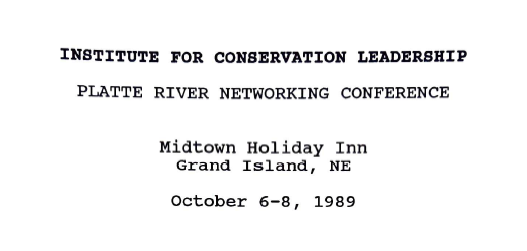
I can personally attest—I became mesmerized by the cranes during my early work with the Institute for Conservation Leadership (ICL). As a project within National Wildlife Federation (NWF) and collaborating heavily with National Audubon Society (Audubon), ICL organized a networking meeting among leaders from the three Platte River states in October 1989 in Grand Island, Nebraska. Preparing to co-facilitate that three-day workshop, I remember watching an Audubon video. Seeing thousands of cranes noisily converge on the Central Platte River for the spring migration created a sense of deep wonder and awe.
In that meeting ICL supported an early opportunity for roughly 40 leaders to connect, learn and strategize for ways to better conserve the Platte River. The gathering instigated follow-up meetings and work in each state and the national level in the following decades.
Current Collaboration to Conserve the Platte River
This year, to actually experience what I had felt from watching the video, my family and I planned a March return to Grand Island and Kearney Nebraska to witness North America’s biggest wildlife spectacle. We planned early morning and evening outings in the blinds at the Iain Nicolson Audubon Center at Rowe Sanctuary and the bridge at the Crane Trust Nature and Visitor Center.
Curious about the current status of the work to protect the Platte River, I contacted the staff at Rowe Sanctuary. Marcos Stoltzfus (Center Director) and Melissa Mosier (Platte River Program Manager for Audubon Great Plains) generously agreed to meet with me during our family’s time in Kearney and in a follow-up meeting.
It was encouraging, meaningful, and inspiring to see how the work for the Platte River – now threatened even more by unpredictable snowpack and rainfall in the Rockies – has grown and deepened. Collaboration continues to be at the heart of the arduous work to maintain a variety of habitats and to keep the channel open for the cranes and other migrating birds.
While Audubon staff play big roles, Marcos and Melissa lifted up their partners throughout the discussions. They were adamant that each group plays an important role, and only through joint work will they be able to accomplish the critical management strategies of the Platte River.
What started with initial connections in the 1980s to engage leaders across the diverse watershed of the Platte has now grown to be multiple wide-ranging and comprehensive collaborative efforts. Collaborations include a range of efforts such as:
- Vision for an Ecologically Sound Platte River (VESPR) – VESPR seeks to develop and implement a long-term vision for the Platte River that takes a collaborative, eco-system and science-based approach to water management. By elevating work for long-term ecosystem resilience, VESPR’s joint work through landscape design seeks to increase conservation capacity and actively manage collaborative grants for research. Current focus on the future hydrology of the River seeks to understand the impacts of climate change on Platte water flows. Read more about the details of the 2019 original VESPR plan here.
- Platte River Recovery Implementation Program (PRRIP) – Bringing together Colorado, Nebraska and Wyoming and the Department of Interior, the PRRIP has created a shared partnership approach with water users and environmental groups. Created in 1997, the PRRIP aims to improve and maintain the habitats needed by four endangered and threatened species – the whooping crane, least tern (delisted in 2021), pallid sturgeon and piping plover. PRRIP seeks to implement a shared vision and aims to meet specific targets within the three core strategies of water, land and adaptive management.
- Platte Valley Weed Management Area – Created in 2004, public and private agencies and individuals have cooperated to identify and manage noxious and invasive plants across 13 counties in the Central Platte Valley. The collaborative work especially focuses on identifying significant funding (over $600,000 per year) and resources need to control weeds, especially phragmites, Russian Olive, and cattails that threaten to close the Platte River channel if left untreated.
- South Platte Knowledge Exchange – Over the last few years, and in partnership with other conservation groups, Audubon Great Plains and the South Platte Wetland Focus Area Committee has hosted two immersive field tours and additional meetings. The Exchange pulls together public land and water system managers, university researchers, and nonprofits from Colorado and Nebraska. The Exchange has fostered reflection, cross-boundary cooperation and resource sharing, feeding into a deeper ecological understanding of the South Platte River and the Central Platte River.
- Crane Trust research publications and collaboration – The Crane Trust property and staff serve as a critical hub for research projects and peer-reviewed journal publications shared with the scientific community.
Collaborating Effectively – Lessons Learned
Since Melissa serves as the coordinator for multiple collaborations focused on the Platte River, I sought to tap her experience. She leads from the center of many of the collaborations listed above – all of which have different histories, purposes, cultures, and ways of working. When I asked Melissa what advice she might give other leaders who coordinate collaborations, she immediately rattled off five practices to give attention to in collaborative work:
- Prioritize time and space for informal and fun interactions – Actively plan for sharing food, adding time for chit chat and “getting to know you, and setting up enjoyable outings or events.
- Keep the work relevant to all groups’ goals and work – Take the time (in meetings and one-on-one) to understand each group’s goals; work those goals into the collaboration’s priorities if possible, and make sure each group’s goals are reflected in the collective work.
- Keep up with transitions – As individuals join or leave the collaboration, give good attention to these transitions; bring in new leaders by taking the time to socially connect them with the group and orient them to the way the group works together; when leaders have to depart, take the time to celebrate and recognize their contributions.
- Understand each group’s workload – Use one-on-one conversations and time in meetings to set up the calendar and activities in a way that makes it easier for each group’s participation. By making adjustments for busy times and slow times, meetings and assignments can be better spread out so that everyone can support the collaboration’s workload.
- Make meetings productive and schedule them with intentionality – Set aside regular time for the group to carefully assess and think about how to use meeting time and intentionally think about and adjust the specifics — frequency, time of day, location, length — so that leaders and groups can consistently participate.
Conclusion
Looking back over the last 50+ years, leaders have made significant progress in protecting the Central Platte River Basin. Groups and collaborative efforts have built a body of work that has created a vision, identified needs, brought in significant financial investments, conducted in-depth scientific research, and grown efforts to both protect and then steward the water and land resources of the Basin. In addition, groups and collaborations have also built broad community support for wildlife and communities dependent on the Platte River.
The work of conservation takes not a year, but decades to have impact.
Our vision for our work benefits from looking back at what has happened and then taking stock and plotting the work needed for the decades ahead.
In reflecting on what has happened since that 1989 meeting hosted by the Institute for Conservation Leadership, so much has been built to answer the needs of cranes and other wildlife species dependent on the habitats of the Central Platte River Valley. In dropping back in to experience the spring migration of the sandhill cranes this year, I am grateful for the excuse to catch up on the Platte River ecosystem and the growth in the work to conserve it.
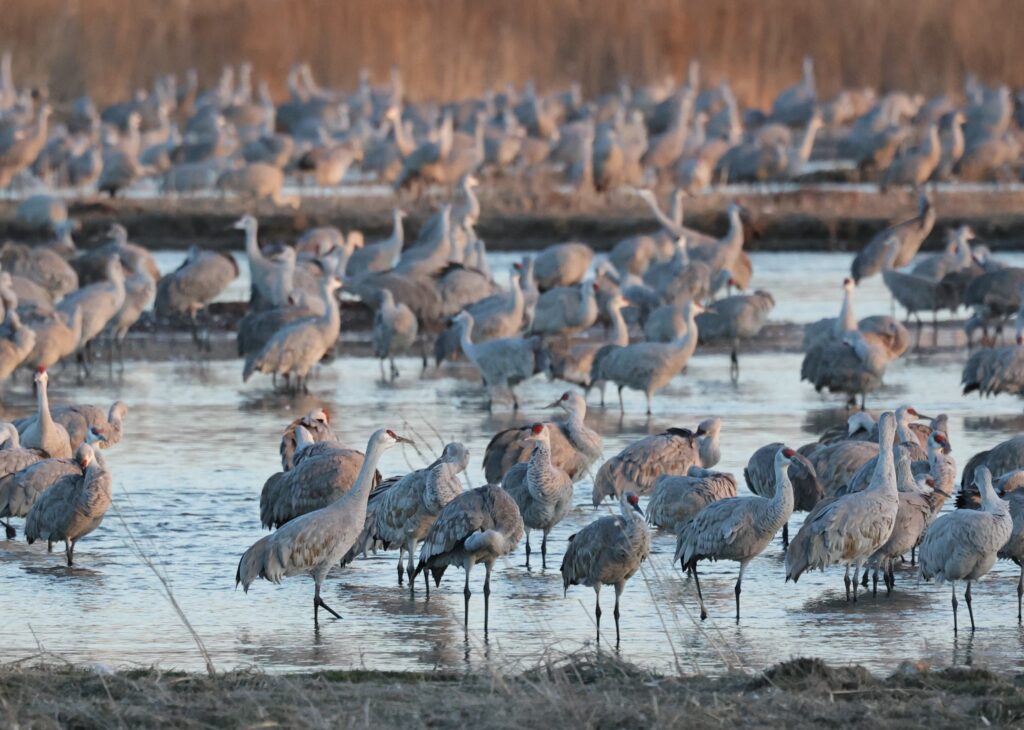
I come away from the experience deeply touched by the sights and sounds of hundreds of thousands of cranes. And I come away with deep gratitude for the people who work collaboratively, day by day, to make sure future generations might have the same amazing and awe-inspiring experience of more than a million migrating cranes.
Resources
- Learn more about the cranes: Whooping Cranes and Sandhill Cranes
Historical References
- Records of the Platte River Whooping Crane Maintenance Trust, Inc. at Colorado State University, 1980 to 2006
- The Platte River Cooperative Agreement: A Basin-wide Approach to Endangered Species Issue – digital commons of the University of Nebraska-Lincoln
- Platte River Recovery Implementation Program – 2005 fact sheet about the founding history
- Bringing the Magic Back to the Platte – National Wildlife Federation Magazine, April 2000
- Saving the Platte – High Country News
- Platte Valley Weed Management Area – 2009 Fact Sheet
- Platte River Timelapse Project – at University of Nebraska Kearney’s Walker Art Gallery